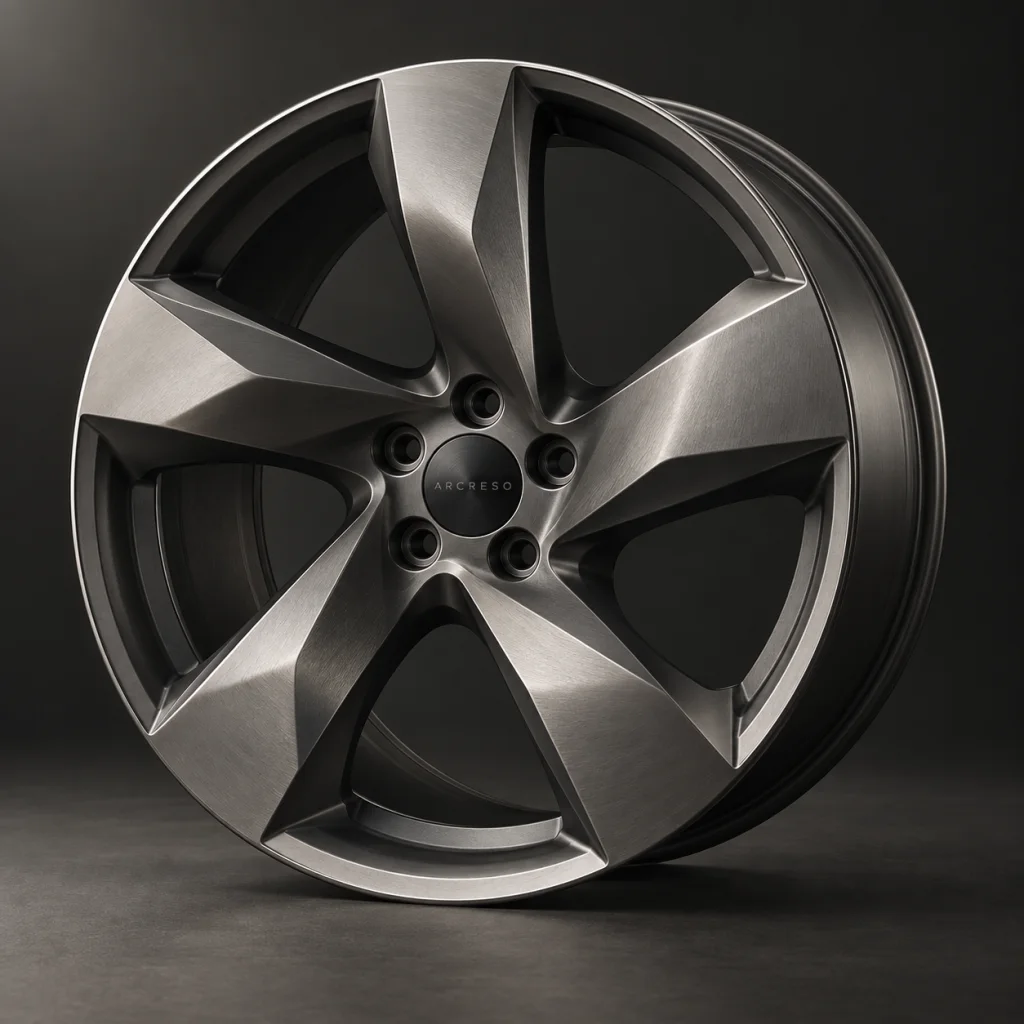
Keep the wheel design and diameter the same, then change the surface. The spokes can become easier to read, the rim can catch a brighter edge, or the entire wheel can sit more quietly inside the arch. Finish changes how a shape meets light. Begin with the part of your build you want people to notice.
01 / Read surface, reflection and contrast.
VISUAL COMPARISON / SURFACE / REFLECTION / CONTRAST
ONE SHAPE. FIVE WAYS TO READ IT.
Follow how the surface makes the same spokes and rim more or less visible.
Fine directional lines.
Brighter reflected edges.
Soft tonal separation.
Sharper reflected highlights.
A warmer color accent.
APPEARANCE STUDY · The geometry stays the same. Stylized surfaces illustrate reflection and contrast; these are not measured finish samples or confirmed production options.
Use three questions when comparing references. What is the surface character? How does it reflect the surroundings? How clearly does it separate from the tire, wheel arch and body color? These questions explain why two finishes described as silver, or two described as black, can give a different impression.
The illustrations hold the spoke layout constant and simplify the light. A real result also depends on the finish sample, viewing angle and environment. For examples of established finish vocabulary, Vossen’s own finishing catalogue distinguishes brushed and polished surfaces, plus satin and gloss colors. Those are Vossen examples; ARCRESO finish availability is confirmed for each project.
02 / Brushed makes the surface legible.
A brushed visual direction brings fine lines into the face of the wheel. Under suitable light, the surface has a direction as well as a tone. Follow a spoke from the outer rim toward the center and notice how the texture helps describe its width, curve and transition.
This can suit a build where you want the wheel’s geometry to stay visible without every surface becoming a strong reflection. The ARC-01 concept study uses a light, textured-looking face as a visual reference. It represents an appearance direction, with the actual sample and process still to be agreed.
03 / Polished picks up the surroundings.
A polished appearance can bring bright highlights and more recognizable reflections into the wheel. Buildings, sky and nearby surfaces may become part of the face. Broad spokes offer larger areas for those reflections; narrower spokes can break them into smaller flashes.
Look at the whole car as well as the close-up. A striking studio highlight may become quieter in shade. Compare an outdoor reference with one under soft light, and ask which impression suits the body color and trim. The surface changes the reading of the design as the lighting changes.
04 / Dark finishes need a readable edge.
Satin dark and gloss dark can share a color family while presenting different highlights. A satin direction often reads through gentler tonal transitions. A gloss direction can produce sharper reflected shapes. Neither label guarantees that every spoke will remain visible in every setting.
On a dark car, the wheel can merge visually with the tire and arch when there is little separation between their tones. An illuminated rim edge or spoke face may restore that separation. On a lighter car, the dark wheel may read more strongly as a complete silhouette. See Design Note / 003 for a closer look at light, contrast and the arch relationship.
05 / Bronze introduces a warmer accent.
Bronze offers a warmer visual direction beside black, gray or silver bodywork. A subdued bronze can remain close to the overall palette; a brighter tone can make the wheel a distinct accent. The same color family can feel different on a broad-spoke face and a finer layout such as the ARC-02 design study.
Treat bronze as a family of references. Shade, surface and reflected light all affect the appearance. Review the proposed sample beside your paint and trim before selecting the final direction.
06 / Prepare a finish brief.
Send a photo of your car in daylight, its body color, and two or three wheel references. Mark what you like: the lighter face, visible texture, darker recesses, warmer tone or reflected edge. Include a whole-car reference so the wheel’s relationship with the body is clear.
Ask to review a sample and the proposed finish specification, including care guidance and the project’s available options. Screen images can shift with the display and camera. A visual preference also says nothing by itself about coating durability, corrosion resistance or wheel weight; those require their own evidence. Use Custom Wheels to turn the visual direction into a useful brief.
Choose the way your wheel reads.
Start with a design, then tell us the surface character and contrast you want. Share the vehicle details you have. The finish, dimensions and project arrangements are reviewed together before a proposal is confirmed.